
Unknowingly, we interact with Linux every day. When launching an app on an Android smartphone, accessing a favorite website, or using a streaming service, almost all of those activities run on top of Linux servers. However, for many people, Linux still feels unfamiliar and is considered a tool used only by programmers with text-filled terminal screens. That image is not entirely wrong, but it does not provide a complete understanding.
This first chapter will build a correct understanding right from the start. The discussion is not merely about definitions, but also covers the reasons behind the existence of Linux, its conceptual inner workings, and the relevance of understanding it for anyone seeking a career in technology. The discussion begins from the basic foundation: the definition of an operating system, the true nature of Linux, and its position in today's technological landscape.
1.1 Operating Systems and Their Roles
We need to understand the definition of an operating system and the reasons for its existence before diving deeper into Linux.
A computer is a set of hardware consisting of a processor, memory, storage, graphics card, keyboard, screen, and other components. All of these components cannot directly communicate with one another or run applications like browsers or games independently. The role of an operating system becomes crucial in this condition.
An operating system (OS) is software that acts as an intermediary between hardware and the user, including the applications run by the user. This system manages all computer resources and provides an environment that enables other programs to run.
An OS performs the following functions:
- Process management: arranges the turn of programs to use the processor.
- Memory management: allocates and frees RAM for every running program.
- Storage management: organizes files on disk through a file system and manages read-write access.
- Hardware management: communicates with hardware components through drivers so applications do not need to understand the technical details of each device.
- User interface: provides a way for users to interact with the computer via a command line or graphical user interface (GUI).
We would have to write programs in machine code and manually configure every hardware detail if there were no OS. Doing so would be highly impractical.
Microsoft Windows, Apple macOS, and Linux are the most widely recognized operating systems today. All three execute the same primary functions, yet use different approaches, philosophies, and architectures.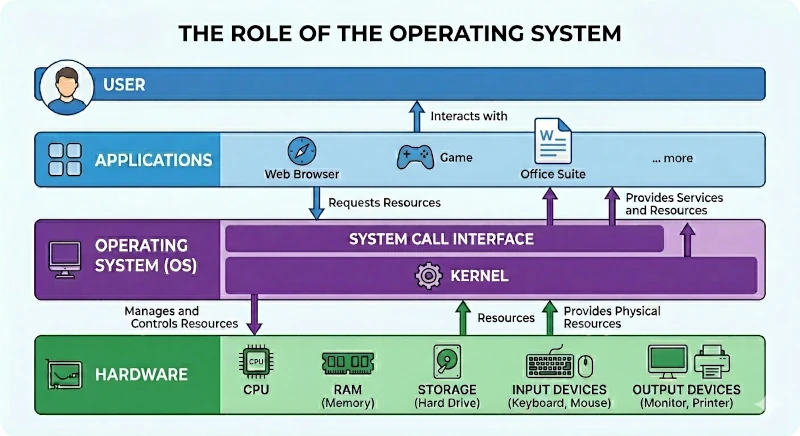
1.2 What Is Linux and What Is a Kernel
1.2.1 Kernel: The Core of an OS
Every OS has a core part called a kernel. The kernel is a software layer that interacts directly with hardware. Its job is to translate instructions from programs into commands understood by the processor, memory, and other hardware components.
The kernel operates at the lowest level in a space called kernel space. This memory space is protected and can only be accessed by the kernel itself. The applications we operate run in user space and communicate with the kernel through system call mechanisms. In practice, sysadmins rarely touch kernel space directly in daily work, but still need to understand this boundary because a crash at the kernel level (a kernel panic) is far more fatal than a standard application crash that only touches user space.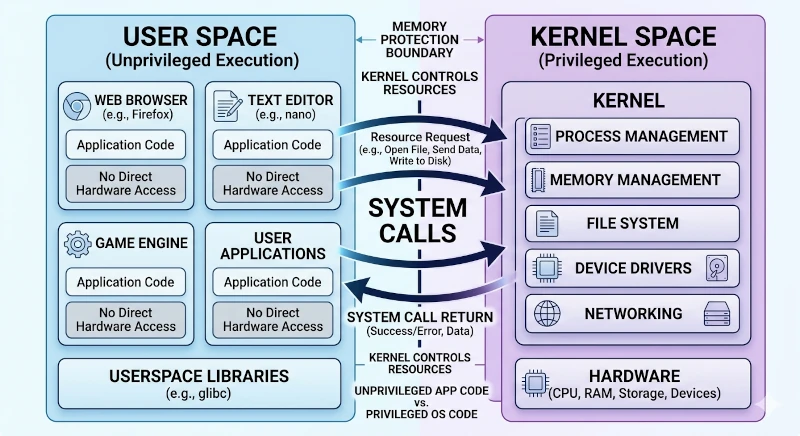
1.2.2 Linux: A Kernel, Not a Complete OS
Linux is the name of a kernel and technically not the name of a complete OS.
Linus Torvalds, a 21-year-old Finnish student, created Linux and announced his project on August 25, 1991, via the comp.os.minix mailing list:
"I'm doing a (free) operating system (just a hobby, won't be big and professional like gnu) for 386(486) AT clones."
The Linux kernel was designed as a monolithic kernel. This means most core functions such as process management, memory management, drivers, and file systems run within a single integrated kernel space. This approach differs from a microkernel, which separates these functions into distinct processes.
Regular users cannot use the Linux kernel directly. The kernel needs to be equipped with various components to become a complete OS, including:
- GNU utilities: a collection of basic programs such as
ls,cp,mv, andbash, mostly originating from the GNU project. - Shell: a command line interface that serves as the interaction interface with the system.
- Desktop environment (optional): a graphical interface such as GNOME or KDE Plasma.
- Package manager: a system to install and manage software.
- Various other supporting components.
Combining the Linux kernel with all these supporting components forms what is packaged as a Linux distribution or distro, such as Ubuntu, Fedora, Debian, Arch Linux, and hundreds of others.
1.2.3 Linux Kernel Versions
The Linux kernel undergoes active development with a release cycle roughly every 9 to 10 weeks. The 6.x series, running since 2022, officially ended at version 6.19 and was replaced by the 7.x series, which began with the release of Linux 7.0 on April 12, 2026. Note that major version bumps do not indicate massive architectural changes, but rather reflect Linus Torvalds' habit of incrementing the major number once minor numbers get too large. Run the following command to check the running kernel version on your system:
uname -r1.3 Linux vs Windows vs macOS: A Quick Comparison
The following comparison helps us see the advantages and context of Linux compared to other operating systems more clearly.
| Aspect | Linux | Windows | macOS |
|---|---|---|---|
| Licensing | Open source (GPL) | Proprietary | Proprietary |
| Cost | Free | Paid | Free (tied to Apple hardware) |
| Source code | Open | Closed | Partially closed |
| Kernel | Linux kernel | Windows NT kernel | XNU kernel (Darwin) |
| Developer | Community + Corporations | Microsoft | Apple |
| Customization | Very high | Limited | Very limited |
| Security | High by design | Vulnerable | Fairly high |
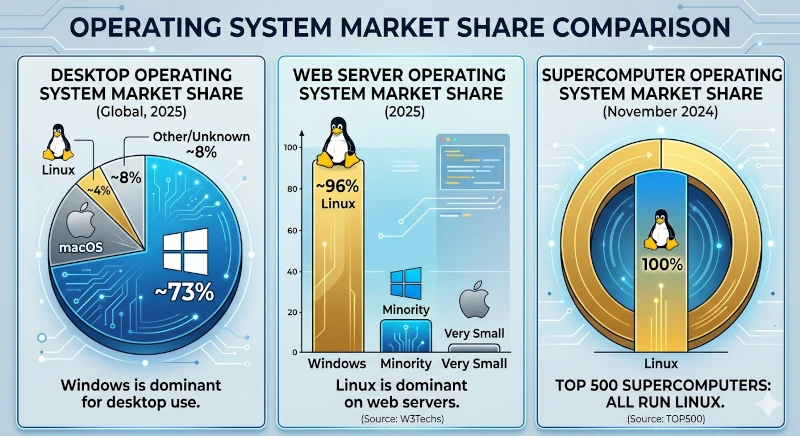
| Desktop usage | Around 4% (2026) | Around 60 to 65% | Around 12 to 15% |
| Server usage | Dominant (Around 96%) | Minority | Extremely small |
| Hardware support | Broad | Very broad | Apple hardware only |
There are several key points to highlight:
- Linux is not a single product: Thousands of contributors worldwide develop Linux with support from organizations like the Linux Foundation. No single company owns it.
- Market dominance: Windows dominates the desktop sector, but Linux dominates servers, cloud computing, and embedded devices, ranging from routers to Android smartphones.
- System base: macOS is UNIX-based, sharing conceptual similarities with Linux, but is restricted to the Apple hardware ecosystem.
- Market share figures are estimates: Desktop usage data above originates from web traffic tracking (such as StatCounter) and can vary significantly from month to month and across measurement sources, as this method does not directly count total installations.
1.4 Why Learn Linux?
1.4.1 Job Market and Tech Careers
The tech industry heavily relies on Linux. Proficiency in Linux is a fundamental requirement for various tech career paths.
Job market demand:
- Positions such as system administrators, DevOps engineers, site reliability engineers (SRE), and cloud engineers require Linux expertise.
- Major cloud platforms such as AWS, Google Cloud Platform (GCP), and Microsoft Azure run the majority of their workloads on Linux.
- Windows remains the most used primary OS by professional developers according to the 2025 Stack Overflow survey (around 49.5%), but various Linux distributions combined are used by a proportion of developers comparable to or surpassing macOS users (around 33%). These figures reinforce Linux's position as a main workstation environment among professional developers, rather than just a niche OS.
Relevant certifications:
Many prestigious industry certifications are Linux-based, including:
- CompTIA Linux+
- LPIC-1 and LPIC-2 (Linux Professional Institute)
- RHCSA / RHCE (Red Hat Certified System Administrator / Engineer)
- CKA (Certified Kubernetes Administrator)
1.4.2 Software Development
Linux serves as the de facto development environment standard for software developers:
- Production servers: Web applications will almost certainly be deployed to Linux servers. Developing in a matching environment reduces compatibility issues.
- Containers: Container ecosystems like Docker and Kubernetes were born and optimized for Linux. Kernel features such as namespaces and cgroups form their foundation.
- Tooling: Many compilers, interpreters, and build tools are more stable on Linux.
- Git: Linus Torvalds created Git, and modern Git workflows thrive in the Linux ecosystem.
- WSL (Windows Subsystem for Linux): The presence of a Linux compatibility layer inside Windows proves just how critical Linux is for developers.
1.4.3 Servers and Cloud Environments
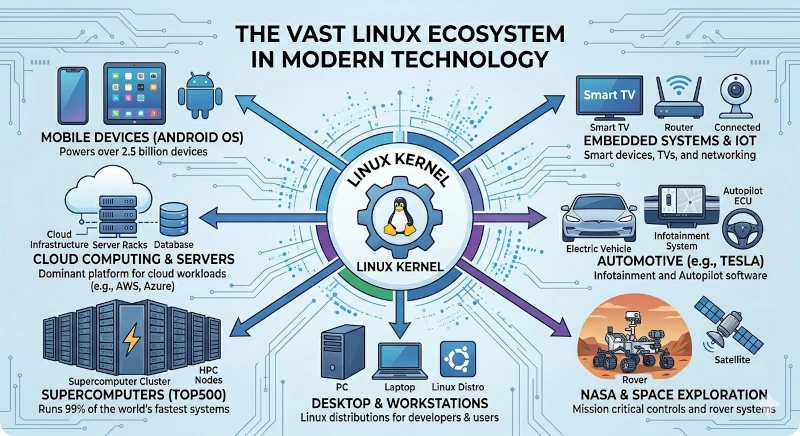
Linux is unmatched in this domain:
- Web servers: The majority of web servers on the internet run Linux. Apache and Nginx are optimized for this system.
- Cloud computing: Global cloud infrastructure built on Linux remains the primary choice across service providers.
- Supercomputers: All 500 of the world's fastest supercomputers use Linux.
- Android: The most popular mobile OS in the world uses the Linux kernel.
- IoT and embedded systems: Smart devices such as routers, smart TVs, and automotive systems are heavily Linux-based.
1.5 Who Uses Linux?
Linux is used by a broad spectrum of users, ranging from beginners to the largest organizations in the world.
1.5.1 Individual Users
- Developers: due to its robust tooling ecosystem and consistent environment relative to servers.
- System administrators: due to full system control.
- Researchers and academics: due to flexibility, scripting capabilities, and access to scientific software often available exclusively on Linux.
- Privacy and security enthusiasts: due to auditable open source code and full control over what runs on the system.
- Desktop users: especially those seeking a free alternative to Windows or macOS, or looking to revive older computers.
1.5.2 Enterprises and Organizations
Major organizations relying on Linux include:
- Google: its entire server infrastructure runs on Linux. Android uses the Linux kernel.
- Meta (Facebook): operates one of the world's largest Linux infrastructures.
- Amazon: AWS, one of the largest cloud services, is built on Linux. Amazon develops its own distro: Amazon Linux.
- NASA: uses Linux for various scientific computing systems.
- New York Stock Exchange: uses Linux for stock trading systems.
- Wikipedia: Wikipedia's entire server infrastructure runs on Linux.
- Tesla: infotainment and autopilot systems utilize Linux.
- SpaceX: Falcon 9 flight software systems run on Linux.
1.5.3 Governments
Governments across various countries switch to Linux to cut costs and reduce reliance on proprietary software:
- Germany (Munich): The city of Munich migrated around 15,000 computers to Linux through the LiMux project (2003 to 2013), but the city council decided to revert to Windows in 2017 due to application compatibility issues and user dissatisfaction. Interestingly, Munich's new governing coalition recommitted to the "Public Money, Public Code" principle starting in 2020 and reinforced that commitment in 2026 through the city's Open Source Program Office (OSPO). This case demonstrates that large-scale migrations like this can reverse direction more than once.
- Germany (Schleswig-Holstein): Unlike Munich, the state of Schleswig-Holstein reported that around 80% of its government workstations moved from Microsoft software to open-source alternatives as of 2025, making it one of the most successful government Linux migrations in Europe today.
- France: The French government in 2026 announced plans to migrate around 2.5 million government devices from Windows to Linux and other open-source software as part of digital sovereignty efforts.
- India: BOSS Linux (Bharat Operating System Solutions) was developed by the Indian government.
- China: develops its own Linux-based distros (Kylin OS, Deepin) and promotes their adoption in government institutions.
- Brazil: was once one of the largest adopters of Linux within the government sector.
1.6 Summary
In this chapter, we have established a foundational understanding of Linux:
- An operating system acts as an intermediary between hardware and users to manage computer resources.
- Linux is technically a kernel created by Linus Torvalds in 1991.
- A Linux distribution combines the kernel with supporting software to form a ready-to-use OS.
- Linux excels in open-source licensing, security, customization, and dominance in the server sector.
- Mastering Linux is highly relevant for modern tech careers such as DevOps and cloud computing.
- Linux users range from individuals and massive corporations to government institutions worldwide.
In the next chapter, we will delve deeper into Linux history, starting from the origins of UNIX at Bell Labs in the late 1960s, the birth of the GNU project, to the emergence of the Linux kernel that transformed the technology landscape.