
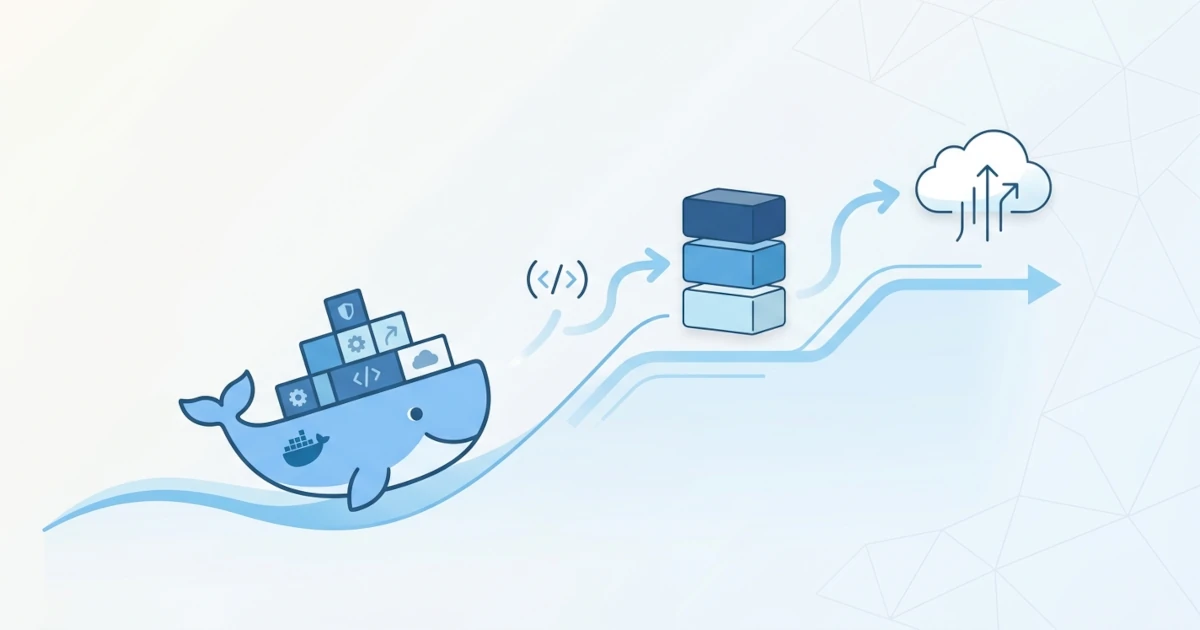
"Learning Docker: From Beginner to Advanced" is a containerization learning series that guides us through a complete journey with Docker, starting from the most basic question "what is a container?" to maturely operating containers in a production environment. This series is designed for the two roles that most frequently interact with Docker in daily work: Developers who use containers to package and run applications, and Sysadmins/DevOps Engineers who are responsible for keeping those containers secure, stable, and efficient when serving real-world traffic.
The entire material is divided into 12 parts and 44 chapters, structured progressively so that each chapter serves as a solid foundation before moving to the next. However, it is written in a way that allows each section to stand alone and be practiced immediately without needing to read sequentially from the beginning.
Part 1: Docker Foundations
The journey begins with Introduction to Docker, discussing what containers are, a brief history of containerization from chroot to the Open Container Initiative standards, comparisons with virtual machines, up to real-world use cases that make Docker worth learning. Afterwards, the material covers Docker Installation on Linux, macOS, and Windows, followed by Basic Docker Concepts, which breaks down the daemon-client architecture, the difference between images and containers, and the container lifecycle as a foundation before practicing Docker commands.
Part 2-3: Working with Images and Container Management
This section explores two sides of the same coin: images as blueprints and containers as actual running instances. The material delves into the layer structure of Docker images, how to write a Dockerfile from scratch including multi-stage build techniques, and managing image collections that accumulate over time. On the container side, topics include a comprehensive guide to docker run, interacting with running containers via exec and logs, and transitioning through container lifecycle states from start, stop, restart policies, to cleanup.
Part 4-5: Data Management and Networking
Containers are ephemeral, making data storage strategies crucial. This section covers volumes for Docker-managed persistent data, bind mounts for linking host files directly to containers, and tmpfs for temporary data that should not touch the disk. The networking section follows with network drivers such as bridge, host, and overlay, how containers communicate with each other using Docker built-in DNS, and advanced network topologies for multi-host scenarios.
Part 6-7: Docker Compose and Registries
After understanding single containers, the material transitions to multi-container applications using Docker Compose, covering basic compose.yaml syntax, defining multiple services simultaneously, and advanced techniques like override files and startup order configuration with depends_on. The registry section covers distributing images via Docker Hub, building a private registry, as well as tagging and promotion strategies across environments that are secure and easily traceable.
Part 8-9: Security and Production
A container running without security considerations is essentially just a regular process wrapped in namespaces and cgroups. This section covers security practices from three perspectives: basic container security (user privileges, capabilities, read-only filesystems), image security (minimal base images, supply chain, vulnerability scanning), and runtime security (AppArmor/SELinux, resource limits, secrets management). The material continues with production readiness, covering logging strategies, health checks, CI/CD integration, and performance optimization for both images and runtime.
Part 10: Real-World Implementation
Ten case studies apply all previous concepts to real-world scenarios: containerizing Node.js applications, Laravel with PHP-FPM and Nginx, Python (Django/Flask/FastAPI along with Celery), Go with multi-stage builds for minimal binaries, migrating WordPress to containers, full-stack architecture with a reverse proxy, an observability stack with Prometheus, Grafana, and Loki, AI/LLM applications with GPU access, microservices patterns, up to building a complete CI/CD pipeline from commit to production.
Part 11-12: Advanced Topics and Best Practices
The series concludes with topics that scale Docker understanding and operational maturity: Docker Swarm for orchestration and clustering, an overview of Kubernetes as the industry standard for container orchestration, field troubleshooting and debugging techniques, daily development workflows, best practices for writing a Dockerfile, production container operations and maintenance, and an introduction to Docker ecosystem tools like Portainer, lazydocker, Dive, and Watchtower.
How to Learn from This Series
Each chapter is designed with a heavy focus on practice: a brief introduction featuring real scenarios, necessary concepts for baseline understanding, followed by step-by-step instructions that can be tried immediately complete with code blocks, verification, and troubleshooting. Purely conceptual chapters, such as Docker history or comparison with Kubernetes, include summaries and comparison tables for easy scanning. All technical claims, from CLI commands and flags to default behaviors, are cross-checked with official Docker documentation, Docker Compose Specification, Open Container Initiative specifications, and other trusted sources relevant to each chapter.
This series is suitable for readers who are complete beginners to containers as well as those who use Docker daily but want to deepen their knowledge of security, networking, orchestration, and production practices. Parts 1 to 3 are suitable for beginners, Parts 4 to 8 for intermediate users comfortable with basic Docker commands, and Parts 9 to 12 for advanced users ready to bring containers into real production environments.